


 Posts


Text: Matthew 13:24-30, 36-43
Preached July 17 at Grace
Grace, mercy, and peace to you from God the Father and Christ Jesus our Lord. Amen.
We’re talking a lot about seeds and planting lately, it seems. I have no doubt you all know a thing or two about such matters, with all the farmers and gardeners in our midst. But somehow I think even your collective agricultural knowledge might not be enough to fully crack the mysteries Jesus addresses for us today. Wheat and weeds are tricky enough, but the problem of good and evil is most certainly beyond our grasp.
“The kingdom of heaven may be compared to someone who sowed good seed in his field,” Jesus says, and he continues later, “The one who sows the good seed is the Son of Man; the field is the world, and the good seed are the children of the kingdom.” God, through Christ, the Son of Man, made all of creation, and he made it good. But things went awry.
“[W]hile everybody was asleep, an enemy came and sowed weeds among the wheat, and then went away. So when the plants came up and bore grain, then the weeds appeared as well….the weeds are the children of the evil one, and the enemy who sowed them is the devil….”
Martin Luther understood evil as including the devil, the world, and our sinful selves. These things combined to tarnish the initial goodness of God’s creation, and they continue their attempts to thwart God’s purposes.
Where do you see weeds, after all? Throughout the world, to be sure. Watching or reading the news will turn up plenty of examples. But we all have plenty of weeds growing in our own yards as well. There are some sins that keep cropping up no matter how many times we think we’ve uprooted them, and there are always new sins appearing in the mix as well.
With all its causes and in all its various forms, the fact is that evil is a reality in our world, and Jesus isn’t afraid to acknowledge it. Our world is fallen and broken, no longer in full relationship with God.
And, according to Jesus’ parable, the good and evil in the world are now so intertwined that they cannot be separated. The owner of this field tells his workers not to pull the weeds sown by an enemy among the good seed, “for in gathering the weeds,” he says, “you would uproot the wheat along with them.” Good and evil must grow together until the end of the age, Jesus tells us.
It’s uncomfortable to live with this reality, isn’t it? Nevertheless, that seems to be exactly what Jesus expects. I think Isaiah has something to say about it in our first reading as well.
“Thus says the Lord, the King of Israel, and his Redeemer, the Lord of hosts: I am the first and I am the last; besides me there is no god.” So God is God and we are not. If we believe this, and if we intend to let God be God, then the question of whether or not to uproot the weeds among the wheat remains squarely in God’s hands.
How tempting it is for us take matters into our own hands and try to root out the weeds we see. Some weeds are quite obvious and quite damaging and perhaps we could pull those successfully. But other weeds are much more subtle, and it isn’t always easy for us to tell the difference between these kinds of weeds and the good plants around them.
Lucky for us, God has sharper vision than we do, as well as a much better view of the entire field. He knows, as Jesus tells us, that sometimes digging up the weeds would be more disruptive and harmful to the crop than just letting them grow until they can be separated at harvest time.
God speaks further through Isaiah: “who has announced from of old the things to come?...have I not told you from of old and declared it?” God alone is in control of history, and he is constantly revealing and declaring himself. First he does it through the covenant, then through the prophets, and finally through his Son.
And, God says, “you are my witnesses!” God has been and still is and always will be at work in and around us. Jesus tells us that the field is not given over entirely to weeds—there is still good wheat bearing fruit even among the weeds.
There is still good happening in the world—there is still love and forgiveness and compassion. There is still mercy and kindness and courage. There is still patience and generosity and gentleness. We have only to notice it, to revel in it and participate in it, to proclaim it as God’s work.
And so, God says, “Do not fear, or be afraid.” It is not for us to worry about identifying and rooting out all the weeds in the world—everything that seems to be evil. Our part is to trust in God’s sovereignty, realizing that God’s ways are not our ways, as he told us through Isaiah just a couple weeks ago.
Our part is to remember that God has proven his goodness and love in sending his Son to die for us. “There is no other rock,” God says, “I know not one.” God is God and we are not. And this God is a refuge of stability and security and safety, even amidst the storms and sorrow and suffering of life in a world plagued by evil.
And so, trusting in this loving God, we wait with patience and hope, even as we long for God’s promised future. Paul says in our second reading that “the creation waits with eager longing for the revealing of the children of God.” He describes this waiting as “groaning in labor pains” in “bondage to decay.”
All of creation experiences the suffering of sin and brokenness, and we yearn to separate the wheat and the weeds, to rest securely in the kingdom of Christ where no evil can touch us and no harm come to us.
One scholar points out that part of what causes our suffering is that “the Spirit has given us reason to hope for more than we can see….For now, the suffering Paul speaks of…comes from knowing what the world could be, even as we live in the world as it is” (Mary Hinkle Shore on WorkingPreacher).
So the very cause of our hope is also a cause of our suffering! We can see beyond the world into God’s promised future, and so we wait eagerly for its arrival. The eager longing Paul describes is the anticipation of someone straining to see the dawn breaking after a long, restless night. It is the yearning of someone scanning the horizon for the arrival of an expected loved one. It is active longing, always on the lookout.
And the reality of the future God has promised us is precisely why Paul can say, “the sufferings of this present time are not worth comparing with the glory about to be revealed to us.” Suffering is real, and we should never ignore or dismiss anyone’s experience of it. But, even as we suffer, we do not lose hope.
Instead, we endure in the certain hope “that the creation itself will be set free from its bondage to decay and will obtain the freedom of the glory of the children of God.” Or, as Matthew says, “the righteous will shine like the sun in the kingdom of their Father.” In hope we were saved, Paul says, and we wait with eager anticipation for that which we do not see but which has been made sure and certain for us by God’s promise.
The suffering of this life does not have the final word. The evil one who sows weeds among the wheat does not have the final word. Even death itself does not have the final word. God is God, and we are not, nor is anything else in creation. And God will have the final word.
Matthew tells us that God will root out all evil and sin and brokenness at the end of the age. Both the evil around us and the evil within us will be burned away to leave only good grain. Paul tells us we can expect the redemption of our bodies along with the restoration of all creation—a new life fully reflecting the glory of God. John tells us in Revelation that God will wipe every tear from our eyes and death will be no more.
So we trust in this promise, knowing we have “the first fruits of the Spirit.” The first fruits are representative of the full harvest, a pledge of what is to come. We know that God has great things in store for us, because the pledge he has given us is his very Son!
And the Spirit bears witness that we, too, are children of God, and “if children, then heirs, heirs of God and joint heirs with Christ.” We are heirs with Christ in both suffering and glory, death and resurrection, decay and brand-new life. So we wait with patience, trusting God’s promise that he is present in suffering, tending to both weeds and wheat. And we live in the sure and certain hope that, in Christ, God is making all things new. Amen.
July 17 sermon
Sunday, July 17, 2011
Weekly beauty: Sandra Bowden
Friday, July 15, 2011
I can't remember how I stumbled upon Sandra Bowden's art but I know I like it.
Her gallery is organized into categories: text series, archaeology series, collage series, crucifixion series, art history, artist's books, and geological forms.
Samples from the text series demonstrate Bowden's trademark: the inclusion of Hebrew text in the piece. It's compact and not necessarily intended to be read, but becomes part of the art.
Heavens Declare (Psalm 19)
Aaron's Breastplate (a reference to Exodus 28:29, the inscription of the names of the 12 tribes of Israel on Aaron's priestly vestments; the piece also includes Jacob's blessing of his 12 sons, from Genesis 49)
Law and Gospel (a depiction of the two tablets of the Ten Commandments, with an additional horizontal cut to form a cross)
From the crucifixion series, a piece called He Was Wounded for our Transgressions (a San Damiano cross surrounded by words from Isaiah 43)
And from the geological forms series, this is Burst into Song, O Mountains (from Isaiah 49)
There's something quite compelling about such simple forms carrying so many layers of meaning.
Out and about
Thursday, July 14, 2011
I mentioned my trip to Kansas City, and shared some pictures of our family gathering. Here's a bit of our exploits around town.
The sports complex, Arrowhead Stadium (home of the Chiefs football team) and Kauffman Stadium (home of the Royals baseball team).
The Liberty Memorial and National World War I Museum. We drove by without stopping. I hope to visit sometime.
And the beautiful architecture of Union Station.

I also attended another retreat of the Society of the Holy Trinity. It's always a delight to pray together. As a bonus, this was the first time I had been to the Christ the King Retreat House in Buffalo, Minnesota, when it wasn't snowy and frozen.
Beautiful grounds.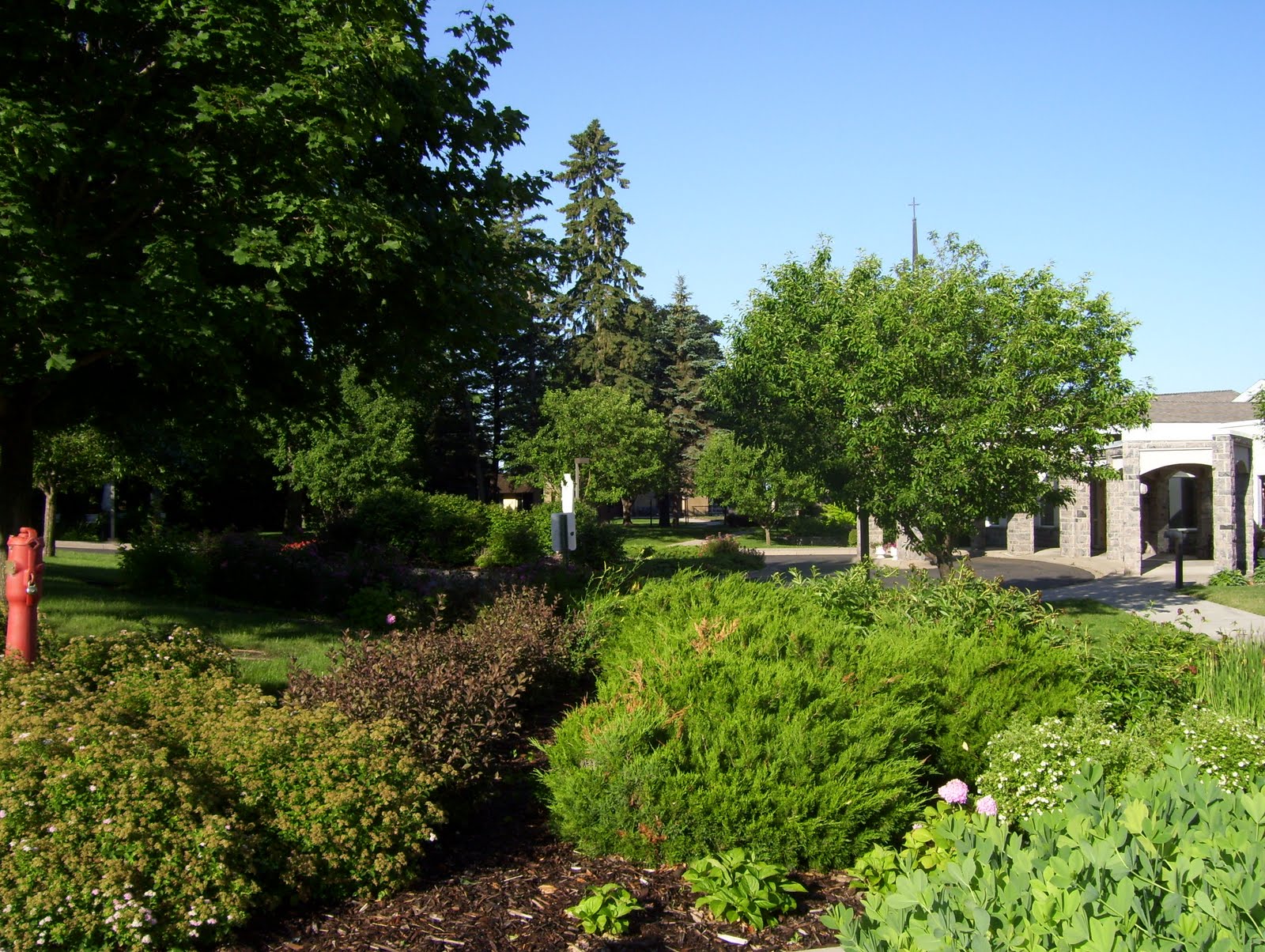
Statue of Moses.
Baby barn swallows. See Psalm 84:3.
Stunning sunset.
Women's retreat day
Tuesday, July 12, 2011
Last weekend I had the privilege of participating in a day of retreat for the WELCA ladies of Trinity. It was a beautiful opportunity for strong women of faith to gather together to pray and study and support one another.
Our gracious hostess had all kinds of goodies available for us, including bubble wands, treats, and customized journals in which she had inserted inspirational resources.
We had lots of time for various types of study and prayer, both individually (like lectio divina) and communally (like the morning prayer liturgy).
We enjoyed lovely refreshments at a beautiful table (and we even tried our hand at napkin origami, just for fun).
And, just for more fun, we played lawn games and blew bubbles while our lunch was being prepared for us. It was delightful.
The conversation and encouragement that emerged from our study and prayer was heartening to all of us, I think. And we obviously had a lot of fun in the process as well.
July 10 sermon
Sunday, July 10, 2011
Text: Matthew 13:1-9, 18-23
Preached July 10 at Trinity
Grace, mercy, and peace to you from God the Father and Christ Jesus our Lord. Amen.
So what do plants need to flourish? Those of us who gathered on Wednesday evening considered this question, and our young people just helped us think through it again. The first thing they need, of course, is someone to plant them. “A sower went out to sow,” Jesus tells us. If God’s people are to grow and bear fruit, God’s word must be planted in the first place. We need a preacher!
Now, by “preacher,” I don’t just mean those of us who get to study and proclaim God’s word during the designated “sermon” time on Sunday morning. That is important, of course (at least, I think it is!). And so are all the other ways in which we share the good news. Jesus wasn’t talking only to pastors when he said at the end of Matthew’s gospel, “Go therefore and make disciples of all nations…teaching them to obey everything that I have commanded you.”
All of us—all of you—who know the story of God’s love made known in Christ are preachers. God has given you his promises—a promise that he has named and claimed you as his own, a promise that nothing in all creation can separate you from his love in Christ Jesus, a promise that he will one day raise his people to eternal life and make all things new. These promises are for you, and they are for everyone around you. That means it’s your job to get the word out there—to be a preacher of the good news!
As we talked about with the kids, this sower doesn’t exactly seem shrewd and skillful about his farming practices, does he? I know those of you who cultivate crops probably have GPS-guided equipment that tells you exactly where the seeds go, and a whole arsenal of other scientific and mechanical tricks to make your efforts as productive as possible.
But this sower doesn’t seem to care where his seeds end up. Thankfully, some of the seed does fall on good soil, where it can grow and produce grain. But some lands on the path, which would have been worn down by foot traffic so that plant roots couldn’t penetrate the crusty surface before it was snatched by birds. Some lands on the rocks, which prevent the roots from getting down into the soil. Some lands among thorns, which steal all the sun and water and nutrients and starve the good plants.
The sower doesn’t seem to have much concern for maximizing his yield through careful planting. Instead, there seems to be an abundance of seed and little worry for precision. This is how God works with his word—he scatters it all over the place, through all these preachers he’s commissioned. And so we go—you go—and spread that word far and wide, regardless of where it might end up.
It is true, of course, that conditions must be right for the plants to grow. The seed must get its roots into the soil. Jesus says, “When anyone hears the word of the kingdom and does not understand it, the evil one comes and snatches away what is sown in the heart; this is what was sown on the path.”
There are plenty of folks in Matthew’s gospel who hear but do not understand. How about the religious leaders who hear Jesus’ message but oppose him every step of the way? How about the crowds who seem to love the healings and miracles but eventually turn on Jesus and put him to death?
How about our own pride and prejudices? How often do we think we can do better on our own than with God’s guidance? How much does our culture emphasize individuality and following our own desires, not letting anyone tell us what to believe? The word cannot sink in when hearts and minds are not open to receive it.
Once it does penetrate that top layer of soil, the seed must be rooted deeply. Jesus continues: “As for what was sown on rocky ground, this is the one who hears the word and immediately receives it with joy; yet such a person has no root, but endures only for a while, and when trouble or persecution arises on account of the word, that person immediately falls away.”
If you’re anything like me, you can easily get excited about a new undertaking, but the enthusiasm isn’t always sustainable. It could be college majors, careers, or hobbies. You get fired up about something so you spend money on photography equipment or musical instruments or sewing supplies or sports gear. But, as soon as you realize you’re going to have to work hard to be any good at this new endeavor, your enthusiasm vanishes and your shiny new things sit unused.
This is not the nature of discipleship, is it? Discipleship is long-term. It has to weather all the good, bad, and unremarkable times. Christians do not live on enthusiasm alone, but discipleship happens amidst the mundane routines of daily life.
The occasional mountaintop experience of closeness with God can be rejuvenating, and it is a blessing when it happens, but it cannot be the central substance of our faith lives. Faith is nourished in the community of Christ’s body, the church, and sustained by God’s word, and the sacraments, and spiritual disciplines like prayer.
Persecution and suffering is a reality. The disciples and the early church faced plenty of reasons for despair—both physical harm and rejection of the message in which they believed. We too are vulnerable to the suffering of life and the rejection of our efforts to reach out with the good news of God’s love. We must have roots deep enough to handle these challenges if we are to continue to grow in Christ.
When the seeds are planted and they’ve managed to establish healthy roots, they aren’t home free yet. What if their territory gets crowded? “As for what was sown among thorns, this is the one who hears the word, but the cares of the world and the lure of wealth choke the word, and it yields nothing.”
Even a novice gardener knows that it’s important to keep weeds out of the garden, so they don’t steal all the nutrients from the plants you want to grow. The word must have adequate space and nourishment.
Matthew tells us of a rich young man who asked Jesus what he must do to have eternal life. Jesus told him he should keep the commandments, and he also said, “sell your possessions, and give the money to the poor, and…follow me.” And the man went away grieving. It seems he just couldn’t give up his possessions.
Many of us live fast-paced lives, juggling competing demands and priorities. And many of these demands—like family, work, and service—are not at all bad or frivolous. But they can still be distracting. Sometimes when I’m taking classes in seminary, I get so caught up in what’s due next that I forget why I’m doing it in the first place.
Obvious distractions like greed are dangerous, but these other, very important, very good things can also cause problems for our discipleship. As Jesus told Martha, only one thing is needed.
Taking time for prayer, praise, study, and fellowship sets up a different paradigm for our time, reminding us that we are not the savior of the world and that all does not depend on us. Discipleship means being set apart from the world and its concerns, so that they do not choke us, even as we are planted firmly in the midst of them.
It’s clear, then, that plants have to have the right conditions in order to grow. And it’s clear that God’s word must be received under the right conditions in order to thrive. But there’s an important thing to note about bad soil—it cannot change itself. A crusty pathway can’t soften itself. A rocky patch can’t throw out the rocks. A plot full of weeds can’t remove them.
Just so, we cannot transform ourselves into good soil for God’s word. The sower sows the seed, but God works the soil. The disciples are a good example. They often don’t seem to understand what Jesus is up to, and eventually they betray and deny him as he dies. But Jesus doesn’t give up on them. He continues to teach, encourage, and love them, and he entrusts his mission to them as he ascends into heaven.
God does not give up on us either. He continually transforms us into receptive soil that bears good fruit. Through Christ, God makes us good soil, and God’s Spirit continually works on the spots in our lives that are still hardened, rocky, or thorny.
It’s also important to remember that we can’t change anyone else’s soil type any more than we can change our own. As we sow the seed of God’s promises, we may not always find a warm reception. But even in the face of indifference or hostility, we can’t tell when or where God is at work, transforming the hardened, rocky, or thorny parts of other people’s lives just as he does ours, making them into receptive soil that can hear and understand God’s message of love and grace.
So we sow God’s word extravagantly, no matter what condition the soil seems to be in, and we trust that God will give the growth. You farmers and gardeners surely don’t expect every single seed you plant to germinate. Some of them might wash away or get pounded by hail or wither up mysteriously. But you plant them anyway, trusting that there will be a harvest.
Isaiah’s metaphor of snow and rain in our first reading points to the transformational effect of God’s word in the lives of its hearers:
“For as the rain and snow come down from heaven, and do not return there until they have watered the earth, making it bring forth and sprout, giving seed to the sower and bread to the eater, so shall my word be that goes out from my mouth; it shall not return to me empty, but it shall accomplish that which I purpose, and succeed in the thing for which I sent it.”
The moisture of snow and rain, in combination with good soil and sunshine, ensure food for the season. God’s word does what its hearers need it to do, bringing God’s promises even into treacherous territory.
This assurance gives us freedom to take risks for the gospel, recklessly scattering that good news all over the place with no requirements about the worthiness of the recipient. That’s how God works, after all—we are all unworthy recipients of grace, mercy, and forgiveness, but God gives it freely.
Faithful sowing means giving freely that which we have been freely given—trusting that God will give the growth so that the word “bears fruit and yields, in one case a hundred-fold, in another sixty, and in another thirty.” Because, whether or not we can see it, God has promised that his word will not return empty, and the harvest is assured. And God keeps his promises. Amen.
Weekly beauty: Missouri mural
Friday, July 8, 2011
On our way to Kansas City last weekend, my parents and I stopped at a rest stop / welcome center near Eagleville, Missouri, where we found this lovely work of art.
The woman working in the welcome center saw me taking pictures and kindly brought me a brochure explaining the piece's history and images. It's a glass tile mosaic and was created by Carl and Sandra Bryant, owners of Showcase Mosaics of Lynden, Washington.
Images below include outlaw Jesse James (born and later killed in Missouri), tenor saxophonist Coleman Hawkins (a nod to the great KC jazz tradition), explorers Lewis and Clark, the Liberty Memorial and National World War I Museum (in Kansas City), and a baseball player representing the Negro National League, organized in Kansas City in 1920.
Depicted in this half are Missouri wildflowers and wildlife, artist Thomas Hart Benton (born in Neosho, MO), President Harry S. Truman (born in Independence, MO), and the barn from Walt Disney's youth (in Marceline, MO).
Finally, the center portion features pioneers using the many major wagon trails that passed through Missouri.
As a lover of both beauty and history, I thought this mural was captivating. And what an unexpected place to find such a work!
Baptism weekend
Wednesday, July 6, 2011
I know it was the Fourth of July, and a lovely holiday it was. But, for our family, my niece's baptism took center stage instead. I started out my vacation with a visit to sweet little Annika, made a stop in Iowa, then rounded out the trip with some time in Kansas City for Dayla's baptism.
She has grown so much since I saw her last, and looks even bigger to me after my time with Annika.
Big girls have to look after their animals and take care of their farmyards.
And now that she's eating some solid food, she wanted to skip straight to the lefse. The girl knows her stuff.
The baptism was joyous, as is always the case when Christ claims another child as his own. Dayla wore a dress that has been in my sister-in-law Sarah's family for almost 90 years, and has been worn by at least 36 people for their baptisms, so that was quite special.
And her other sponsor (besides me, that is), Sarah's brother, came prepared with baby goggles just in case full immersion was the order of the day. Turns out Dayla didn't need the goggles for the baptism itself, but how could we pass up a photo op like this afterward?
The family convivium after the worship service was beautiful as well, and Dayla had a grand time being passed from one loving person to the next.
She made a wardrobe change for her party, of course. It's only befitting such a princess. (And who wants to take chances with a 90-year-old family heirloom?)
It was a glorious weekend, and now Dayla Elizabeth is raised to new life, sealed by the Holy Spirit and marked with the cross of Christ forever!
The Amana Colonies
Tuesday, July 5, 2011
Last week during my vacation, my dad and I made a trip to a fun Iowa destination, the Amana Colonies. It's a group of seven villages founded by German Pietists in the mid-1800s. They lived a communal lifestyle until the 1930s; you can read more about the history here. The villages are now a tourist destination with all sorts of cute shops, wineries, and restaurants, still with a German flair.

As we wound our way through the beautiful Iowa countryside, we ran into some kind of little parade of old tractors.

And eventually reached our destination, which was charming, as always, despite a heat index of almost 110 degrees. I was in search of wine, so we hit the Ackerman Winery and the White Cross Cellars.

The Amana General Store is always one of my favorite destinations. It's one of those overstimulating, overcrowded, enchanting places where you can buy kitchen things, knick-knacks of any kind, specialty foods, furniture, and just about anything else you could ever want. Like many of the Amana stores, they have a Christmas room, which was kind-of nice on such a hot day.

And, of course, we had to make a stop to admire the lovely furniture at the Amana Furniture Store, much of it hand-crafted locally. Here's my favorite room: so many beautiful clocks, inculding a wall of cukoo clocks.

One of our usual stops that we skipped today was the Amana Woolen Mill. They have a huge variety of beautiful clothing and housewares, but it was just too hot to even think about blankets and sweaters.

As we wound our way through the beautiful Iowa countryside, we ran into some kind of little parade of old tractors.

And eventually reached our destination, which was charming, as always, despite a heat index of almost 110 degrees. I was in search of wine, so we hit the Ackerman Winery and the White Cross Cellars.
The Amana General Store is always one of my favorite destinations. It's one of those overstimulating, overcrowded, enchanting places where you can buy kitchen things, knick-knacks of any kind, specialty foods, furniture, and just about anything else you could ever want. Like many of the Amana stores, they have a Christmas room, which was kind-of nice on such a hot day.

And, of course, we had to make a stop to admire the lovely furniture at the Amana Furniture Store, much of it hand-crafted locally. Here's my favorite room: so many beautiful clocks, inculding a wall of cukoo clocks.

One of our usual stops that we skipped today was the Amana Woolen Mill. They have a huge variety of beautiful clothing and housewares, but it was just too hot to even think about blankets and sweaters.
We did, of course, visit both the Chocolate Haus and the ice cream store, and I got some wine, so the trip was both enjoyable and successful.
Talking to little girls
Sunday, July 3, 2011
I recently read an article about how we talk to young girls, and the impact our interactions might have on them. It seemed timely, given all the new baby girls surrounding me lately, from Skye to Dayla to Annika.
Lisa Bloom suggests in "How to Talk to Little Girls" that we focus too much on little girls' appearance, feeding into our culture's obsession with looks, especially for women and girls. I've caught myself doing this (as she says, little kids are just too darn cute not to notice it!) so I'm glad I have a couple years to practice before these babies are more interactive.
And, by the way, I think we do similar things to little boys, but the article happens to focus on girls. I'll have to start paying attention to people's interactions with boys vs. girls and discover how much difference there is.
Weekly beauty: Appalachian Spring
Friday, July 1, 2011
It's Independence Day weekend, so it seems appropriate to highlight a piece of music that seems quintessentially American in sound and story, Appalachian Spring by Aaron Copland.
The most well-known section is the seventh, with the variations on a Shaker theme, so here it is, with links below to the rest of the work.
This work was originally a ballet, arranged in eight sections and telling the story of a celebration after the building of a new farmhouse in 19th-century Pennsylvania. Here are excerpts from Wikipedia introducing each section, following Copland's own description:
- Very slowly. Introduction of the characters (a newlywed couple, a neighbor, a revivalist preacher and his followers), one by one....
- Fast....A sentiment both elated and religious gives the keynote to this scene.
- Moderate. Duo for the Bride and her Intended – scene of tenderness and passion.
- Quite fast. The Revivalist and his flock. Folksy feeling – suggestions of square dances and country fiddlers.
- Still faster. Solo dance of the Bride – presentiment of motherhood. Extremes of joy and fear and wonder.
- Very slowly (as at first). Transition scene to music reminiscent of the introduction.
- Calm and flowing. Scenes of daily activity for the Bride and her Farmer husband. There are five variations on a Shaker theme....The melody most borrowed and used almost literally is called "Simple Gifts."
- Moderate. Coda. The Bride takes her place among her neighbors. At the end the couple are left "quiet and strong in their new house."...The close is reminiscent of the opening music.
And here are videos of all eight sections:
Section 1
Section 2
Section 3
Section 4
Section 5
Section 6
Section 7
Section 8
Enjoy Appalachian Spring, and happy Fourth of July!
Subscribe to:
Posts (Atom)